
As display technology evolves toward 16K resolution and higher refresh rates, bandwidth demands have reached unprecedented levels. The emergence of 96Gbps transmission under HDMI 2.2 specifications requires a completely new level of cable design, shielding, and signal integrity engineering. For distributors and system integrators sourcing Wholesale 16K HDMI 2.2 Cable, verifying true 96Gbps performance is no longer optional—it is critical to protecting brand reputation and avoiding costly field failures.
For buyers working with an OEM HDMI 2.2 Cable Manufacturer, understanding how 96Gbps quality is tested ensures that products meet real-world installation demands. This article explains, from a professional manufacturing perspective, five essential viewpoints on how to test and verify the quality of Bulk Ultra96 HDMI Cables.
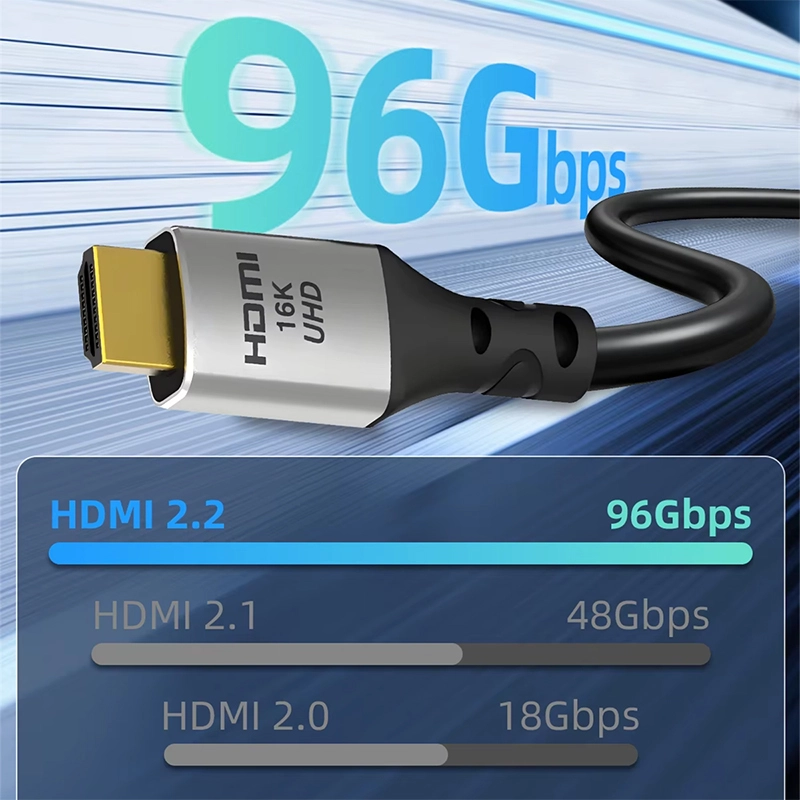
Testing a 96Gbps cable is not as simple as plugging it into a screen and checking for display output. At this bandwidth level, signal integrity becomes extremely sensitive to attenuation, jitter, crosstalk, and return loss.
A reliable Wholesale 16K HDMI 2.2 Cable must undergo laboratory-grade eye diagram analysis using high-frequency oscilloscopes and BERT (Bit Error Rate Test) systems. These instruments simulate real 16K@60Hz data streams and measure whether the cable can transmit without data corruption.
An experienced OEM HDMI 2.2 Cable Manufacturer will test insertion loss across the full frequency spectrum and verify impedance control at 100 ohms differential. Even minor deviations can result in flickering, black screens, or unstable refresh rates in high-resolution environments.
Without this validation, “96Gbps” becomes a marketing claim rather than a measurable performance standard. Professional bandwidth testing ensures that Bulk Ultra96 HDMI Cables deliver consistent data throughput in real-world deployments such as AV integration, esports arenas, and digital signage systems.
At 96Gbps transmission speed, electromagnetic interference (EMI) becomes a major risk factor. High-frequency data signals are extremely vulnerable to external noise and internal crosstalk between twisted pairs.
When sourcing Wholesale 16K HDMI 2.2 Cable, buyers should verify multi-layer shielding structures. This typically includes aluminum foil shielding, braided copper shielding, and individual pair shielding. Testing involves placing the cable in high-interference environments to evaluate signal stability under electromagnetic stress.
A professional OEM HDMI 2.2 Cable Manufacturer conducts EMI chamber testing to simulate industrial and commercial installation conditions. Poor shielding may pass basic display tests but fail in real installations near power lines, routers, or industrial equipment.
Quality Bulk Ultra96 HDMI Cables must maintain stable transmission even in electrically noisy environments. EMI validation ensures long-term reliability rather than short-term laboratory success.
At 96Gbps, signal loss can occur not only in the cable core but also at the connector interface. Poor pin alignment, substandard plating, or inconsistent soldering may cause micro-resistance changes that degrade signal quality.
A dependable Wholesale 16K HDMI 2.2 Cable must undergo connector continuity testing and contact resistance measurement. Gold-plated or high-conductivity alloy contacts should meet strict tolerance standards.
Leading OEM HDMI 2.2 Cable Manufacturer facilities perform automated plug-in cycle testing to simulate thousands of insertions. This ensures mechanical durability and electrical stability over time.
For distributors purchasing Bulk Ultra96 HDMI Cables, connector reliability directly affects return rates. A cable that technically supports 96Gbps but
Not all 96Gbps cables perform equally at different lengths. Signal attenuation increases significantly as cable length grows. A 1-meter cable may pass bandwidth testing, while a 3-meter version may fail without advanced conductor design.
Therefore, every Wholesale 16K HDMI 2.2 Cable must be tested at its specified maximum length. Professional manufacturers conduct attenuation curve analysis and confirm stable 16K video output across full-length configurations.
An experienced OEM HDMI 2.2 Cable Manufacturer may incorporate advanced copper alloys or hybrid fiber solutions to ensure stable long-distance performance.
Buyers of Bulk Ultra96 HDMI Cables should request length-specific test reports rather than assuming identical performance across product variations. This prevents installation failures in commercial or enterprise environments.
Testing 96Gbps performance goes beyond internal factory validation. Third-party compliance testing ensures alignment with HDMI 2.2 standards and future device compatibility.
Reputable Wholesale 16K HDMI 2.2 Cable suppliers will provide compliance documentation, high-frequency lab reports, and quality control certifications. These documents validate that the cable meets strict electrical and mechanical performance requirements.
A reliable OEM HDMI 2.2 Cable Manufacturer invests in long-term R&D and validation processes to ensure that Bulk Ultra96 HDMI Cables remain compatible with next-generation GPUs, displays, and professional AV systems.
Future-proof certification is not just about passing today’s tests—it is about ensuring sustained performance as display technologies evolve.
Looking for high-quality, Wholesale 16K HDMI 2.2 Cable solutions for your project? We specialize in manufacturing high-performance cables and support a variety of customized specifications to meet your various needs. Contact us now to get professional advice and quotes to make your connection better!
Address:D Building Three and Four Floor, No. 32 XinXu Road, Sanxiang town,Zhongshan city,Guangdong province,China
US office: 39-07 prince st suite 4g flushing, New York
Promotional products
EV Charging
HDMI cable
Active Optic Cable
USB Cable
Headphone
Audio Cable
Extention cable
Test Leads
Waterproof cables
TV cable