
As USB-C continues to replace traditional video interfaces, the Type C to VGA cable has become a vital solution for legacy display compatibility. VGA displays remain widely used in offices, schools, factories, hospitals, and conference rooms worldwide. As a professional type c to vga cable manufacturer, understanding product advantages and real-world application scenarios is essential for B2B buyers, system integrators, wholesalers, and brand owners.
This article explores the core advantages, technical strengths, and key use cases of Type C to VGA cables from a manufacturing and supply-chain perspective. Each viewpoint highlights why choosing a reliable usb c to vga cable supplier directly impacts product stability, user experience, and long-term market competitiveness.
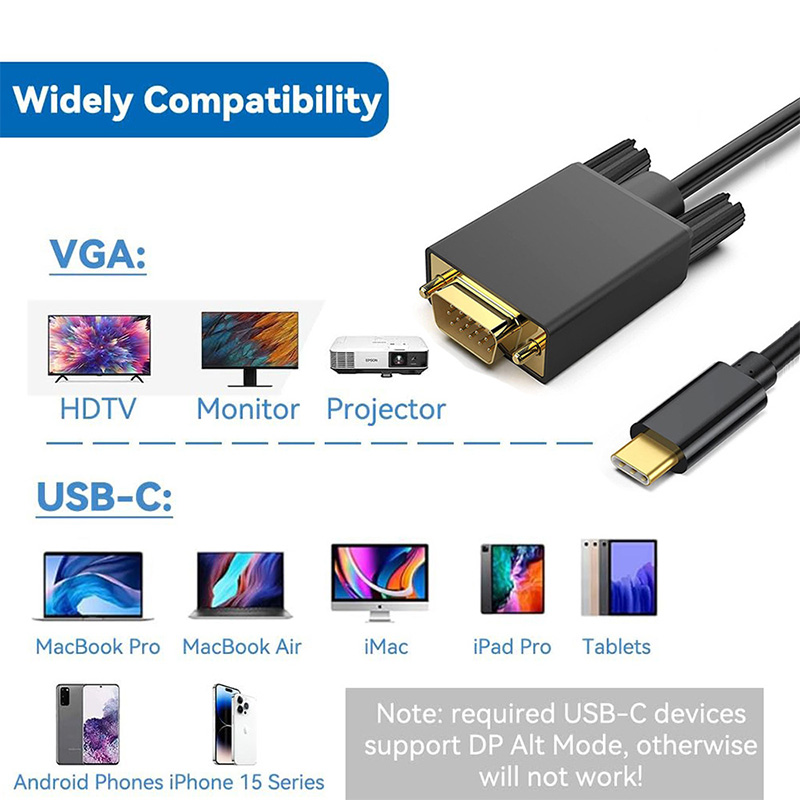
One of the most significant advantages of Type C to VGA cables lies in their wide compatibility across modern and legacy devices. As a professional type c to vga cable manufacturer, ensuring broad device support is a critical design priority.
USB Type-C is now standard on laptops, tablets, smartphones, and mini PCs from brands such as Apple, Dell, HP, Lenovo, ASUS, and Microsoft. Meanwhile, VGA displays are still widely deployed in traditional office monitors, projectors, industrial screens, and classroom equipment. The Type C to VGA cable effectively bridges this technological gap.
Unlike HDMI or DisplayPort, VGA remains popular due to its cost efficiency, durability, and compatibility with older infrastructure. Many enterprises and educational institutions prefer extending the life of their VGA equipment rather than replacing entire display systems. A stable Type C to VGA solution allows seamless upgrades to USB-C devices without additional adapters or converters.
From a manufacturing perspective, a reliable usb c to vga cable supplier must ensure compatibility with:
USB-C DisplayPort Alternate Mode
Windows, macOS, Chrome OS, and Linux systems
Plug-and-play functionality without drivers
High-quality internal chipsets, proper firmware tuning, and strict compatibility testing allow a cable to function consistently across various host devices. For B2B customers, this reduces return rates, technical complaints, and after-sales costs—making compatibility a decisive purchasing factor.
Signal stability is a key differentiator between low-cost products and cables manufactured by an experienced type c to vga cable manufacturer. VGA may be an analog signal, but modern users still expect clear, flicker-free, and stable image output.
A well-designed Type C to VGA cable supports resolutions up to 1920×1080@60Hz, ensuring compatibility with mainstream monitors and projectors. Achieving this requires precise signal conversion from digital USB-C to analog VGA, which depends heavily on:
High-quality DAC (Digital-to-Analog Converter) chips
Shielded internal wiring
EMI and noise interference control
Proper PCB layout and grounding design
Professional usb c to vga cable suppliers invest in component selection and internal structure optimization to prevent common issues such as ghosting, screen jitter, color distortion, or intermittent signal drop.
For commercial buyers—such as corporate IT departments, conference solution providers, and education distributors—display stability directly impacts user trust. A cable failure during a presentation or meeting can cause reputational damage. Therefore, B2B customers prioritize manufacturers with proven signal reliability and strict quality control processes.
Stable transmission is not just a technical feature—it is a business guarantee.
Another major advantage of Type C to VGA cables is ease of use, which significantly enhances deployment efficiency across large-scale environments. As an experienced type c to vga cable manufacturer, designing true plug-and-play functionality is essential.
Unlike active converters that require external power or driver installation, a well-engineered Type C to VGA cable works immediately once connected. This simplicity benefits:
Corporate offices with frequent hot-desking
Schools and universities with rotating instructors
Trade shows and exhibition setups
Temporary meeting rooms and shared spaces
From a system integration perspective, a reliable usb c to vga cable supplier helps customers reduce installation time, minimize IT support requirements, and lower training costs. End users can focus on productivity rather than troubleshooting hardware.
For wholesalers and brand owners, plug-and-play design also reduces after-sales service pressure. Fewer user errors mean fewer complaints and returns, which directly improves profit margins and brand reputation.
Simplicity is often underestimated, but in B2B purchasing decisions, ease of deployment equals cost efficiency.
Despite the rise of digital interfaces, the demand for Type C to VGA cables remains strong due to their versatile application scenarios. A forward-thinking type c to vga cable manufacturer understands that VGA is still deeply embedded in multiple industries.
Key application scenarios include:
Education: Classrooms and lecture halls using VGA projectors
Corporate Offices: Legacy meeting room displays
Industrial Control Systems: VGA-based monitoring screens
Healthcare: Medical equipment with VGA interfaces
Government & Public Institutions: Long equipment replacement cycles
In emerging markets especially, VGA remains dominant due to cost considerations. A dependable usb c to vga cable supplier enables customers to serve these markets without expensive infrastructure upgrades.
This wide applicability ensures consistent order volumes for distributors, OEM clients, and private-label brands. It also allows manufacturers to offer customization options such as cable length, housing material, branding, and packaging—further enhancing B2B value.
In a crowded market, the real difference lies in manufacturing capability and customization flexibility. A professional type c to vga cable manufacturer does more than assemble cables—it provides solutions.
Key manufacturing strengths include:
In-house molding and tooling
Strict incoming material inspection
Signal and aging tests
Custom logo printing and packaging
OEM/ODM support
A capable usb c to vga cable supplier helps clients differentiate their products, adapt to regional market needs, and build strong brand identity. Customization is especially valuable for wholesalers, Amazon sellers, and corporate procurement projects.
Quality manufacturing reduces failure rates, enhances durability, and ensures compliance with international standards—critical factors for long-term B2B partnerships.
The Type C to VGA cable remains a highly relevant connectivity solution in today’s hybrid technology environment. Its broad compatibility, stable signal transmission, plug-and-play simplicity, wide application scenarios, and manufacturing flexibility make it an essential product for global markets.
Choosing the right type c to vga cable manufacturer and usb c to vga cable supplier is not just about price—it is about reliability, scalability, and long-term value. For B2B buyers seeking stable supply and consistent quality, partnering with an experienced manufacturer is the key to sustained success.
Looking for high-quality, type c to vga cable manufacturer for your project? We specialize in manufacturing high-performance cables and support a variety of customized specifications to meet your various needs. Contact us now to get professional advice and quotes to make your connection better!
Address:D Building Three and Four Floor, No. 32 XinXu Road, Sanxiang town,Zhongshan city,Guangdong province,China
US office: 39-07 prince st suite 4g flushing, New York
Promotional products
EV Charging
HDMI cable
Active Optic Cable
USB Cable
Headphone
Audio Cable
Extention cable
Test Leads
Waterproof cables
TV cable