
As electric mobility rapidly expands, charging technology is evolving beyond simple wired power delivery. Among these innovations, the OEM Bluetooth EV charger has emerged as a next-generation solution, offering enhanced connectivity, smart control, and improved reliability for both residential and commercial applications. Compared with traditional EV charging stations, Bluetooth-enabled models—especially advanced versions such as the IP68 Bluetooth EV charger and RFID Bluetooth EV charger—bring a new level of convenience, safety, and intelligent management. This article explores their key differences, major advantages, and future development potential.
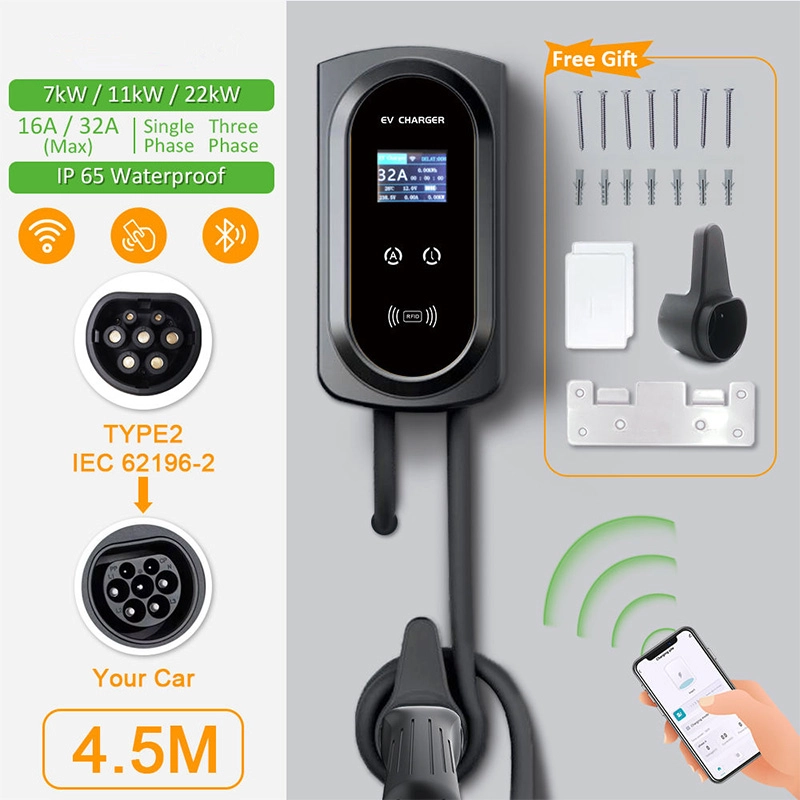
Traditional EV chargers rely mainly on physical buttons, LED indicators, or basic apps connected through Wi-Fi. These options are often limited by signal instability, network incompatibility, or setup complexity. In contrast, an OEM Bluetooth EV charger offers direct, low-energy wireless communication between the charger and the user’s smartphone. Bluetooth requires no network configuration and no internet connection, making it more stable and secure in private or industrial environments.
With Bluetooth pairing, users can monitor charging status, track power consumption, control charging schedules, update firmware, and lock the charger against unauthorized use. For environments such as underground parking lots, workshops, or remote facilities with poor Wi-Fi, Bluetooth offers a seamless alternative. When combined with robust hardware protection—like an IP68 Bluetooth EV charger designed for waterproof and dustproof performance—the charging process becomes more reliable in harsh outdoor weather conditions.
A major challenge with traditional EV chargers is unauthorized access, especially in shared parking spaces, apartment communities, or commercial installations. Conventional solutions rely on padlocks or simple PIN authentication, which are inconvenient and easily bypassed. The new generation RFID Bluetooth EV charger, however, integrates dual-mode security: RFID card identification plus Bluetooth mobile authorization.
This dual-layer system dramatically strengthens identity management. Fleet operators can assign RFID cards to different drivers, monitor usage history, and manage access levels. Meanwhile, Bluetooth allows the administrator to authorize or revoke charging rights instantly from a mobile app. This is far more efficient than reconfiguring hardware or replacing physical keys. It also supports usage tracking and billing for companies operating EV fleets or public charging networks. In short, the combination of RFID security + Bluetooth smart control delivers a modern and highly reliable management ecosystem that traditional EV chargers cannot match.
While standard EV chargers fulfill basic charging functions, they often lack durability and advanced connectivity features required by evolving market demands. Modern OEM Bluetooth EV chargers are engineered with higher safety ratings, upgraded power modules, and intelligent chipsets that support continuous system optimization. Models with IP68 protection offer superior resistance to rain, heat, dust, and corrosion, making them ideal for heavy-duty environments such as outdoor parking, industrial areas, and commercial charging stations.
Looking ahead, Bluetooth EV chargers are positioned to integrate seamlessly with smart energy systems: load balancing, dynamic pricing, solar charging integration, and remote diagnostics. Bluetooth Low Energy (BLE) ensures fast data transmission with minimal power consumption, supporting long-term firmware upgrades and smart-home compatibility. As EV ownership continues to rise, the demand for intelligent, secure, and maintenance-free charging solutions will drive widespread adoption of Bluetooth-enabled products.
Compared with traditional charging stations, Bluetooth-enabled chargers provide significant advantages in connectivity, user convenience, security, and operational management. Whether through the rugged performance of an IP68 Bluetooth EV charger or the dual-authentication system of an RFID Bluetooth EV charger, this new generation of charging technology is reshaping the market. For businesses seeking custom solutions, an OEM Bluetooth EV charger offers flexible design, scalable intelligence, and long-term competitiveness in the rapidly growing EV charging industry
Looking for high-quality, OEM Bluetooth EV charger for your project? We specialize in manufacturing high-performance cables and support a variety of customized specifications to meet your various needs. Contact us now to get professional advice and quotes to make your connection better!
Address:D Building Three and Four Floor, No. 32 XinXu Road, Sanxiang town,Zhongshan city,Guangdong province,China
US office: 39-07 prince st suite 4g flushing, New York
Promotional products
EV Charging
HDMI cable
Active Optic Cable
USB Cable
Headphone
Audio Cable
Extention cable
Test Leads
Waterproof cables
TV cable