
In today’s rapidly evolving AV and industrial connectivity market, choosing the right HDMI cable is no longer just about bandwidth—it’s about durability, environment adaptability, and long-term reliability. As a professional Waterproof Fiber HDMI cable manufacturer, we often receive inquiries about the differences between waterproof and standard fiber HDMI cables. This article provides a clear, structured comparison while highlighting why waterproof solutions are becoming essential across industries.
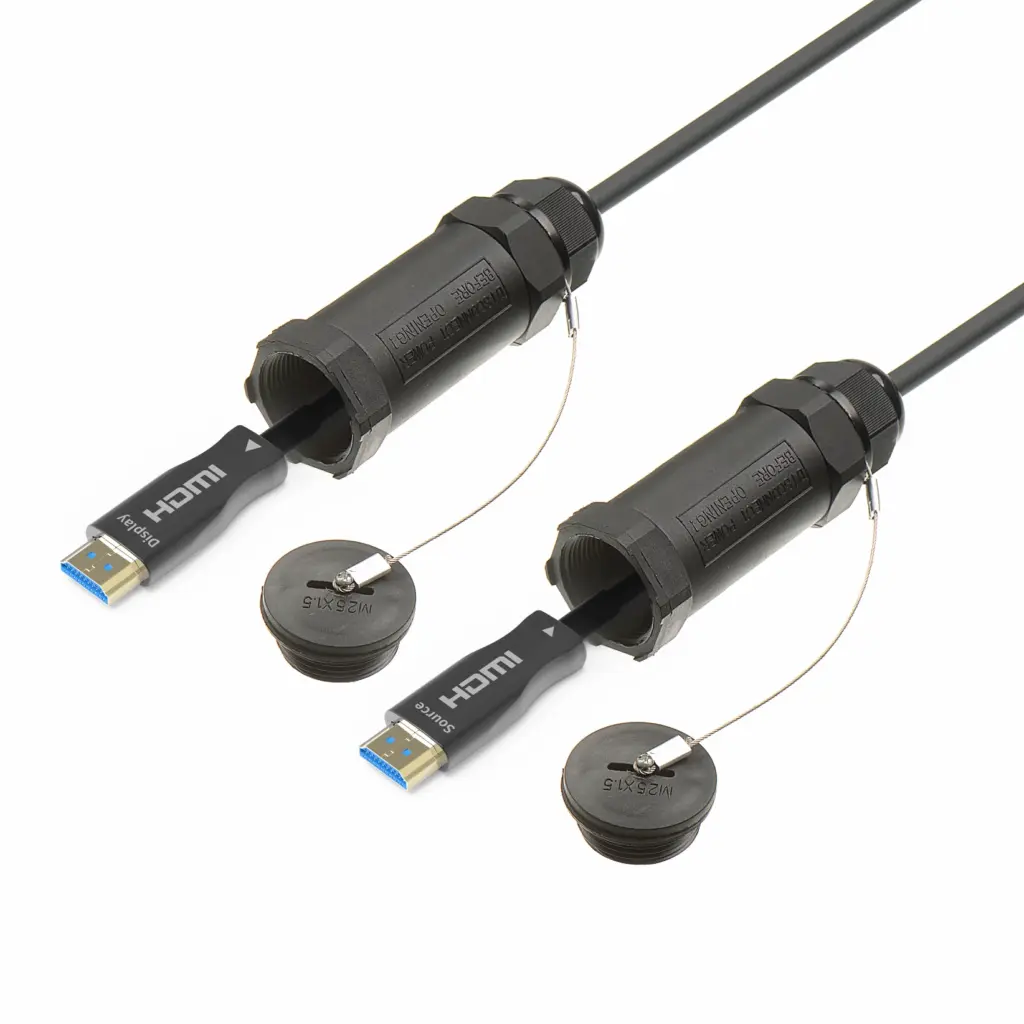
One of the most significant differences between a Waterproof Fiber HDMI cable and a standard fiber HDMI cable lies in their structural design. A typical fiber HDMI cable focuses on high-speed signal transmission using optical fiber cores, ensuring long-distance transmission without signal degradation. However, it is generally designed for indoor or controlled environments.
In contrast, a waterproof version is engineered with reinforced outer jackets, sealed connectors, and enhanced insulation layers. These features allow the cable to resist water ingress, humidity, dust, and even chemical exposure in harsh environments. As an experienced Waterproof Fiber HDMI cable supplier, we integrate IP-rated protection (such as IP67 or IP68) into our designs, ensuring performance even in outdoor or industrial conditions.
Additionally, waterproof cables often include strain relief structures and ruggedized connectors, which significantly improve durability during installation and long-term use. For projects requiring reliability in unpredictable environments—such as outdoor LED displays, marine systems, or industrial automation—this structural advantage becomes a decisive factor.
Standard fiber HDMI cables are widely used in conference rooms, home theaters, and data centers where environmental conditions are stable. While they offer excellent bandwidth and low latency, their performance can degrade quickly when exposed to moisture or extreme temperatures.
On the other hand, ODM Waterproof Fiber HDMI cable solutions are specifically tailored for challenging environments. These include outdoor advertising systems, security monitoring setups, broadcasting equipment, and even military or transportation infrastructure. In such scenarios, exposure to rain, humidity, or dust is inevitable.
As a Waterproof Fiber HDMI cable manufacturer, we have observed that clients increasingly demand customized waterproof solutions to meet specific project requirements. ODM services allow for flexibility in cable length, connector types, jacket materials, and protection ratings. This level of customization ensures that the cable not only performs well but also integrates seamlessly into complex systems.
Ultimately, the broader application range of waterproof cables demonstrates their superior adaptability and long-term value compared to standard options.
While waterproof fiber HDMI cables may have a higher initial cost compared to standard versions, their long-term benefits far outweigh the investment. Traditional cables are more susceptible to environmental damage, leading to frequent replacements, signal interruptions, and maintenance costs.
In contrast, waterproof cables are designed for longevity. Their مقاust sealing, corrosion-resistant materials, and reinforced construction significantly reduce failure rates. As a trusted Waterproof Fiber HDMI cable supplier, we emphasize lifecycle cost savings rather than just upfront pricing.
Moreover, stable signal transmission in harsh conditions ensures uninterrupted performance, which is critical for commercial and industrial applications. Downtime in such environments can lead to significant financial losses, making reliability a top priority.
By choosing an ODM Waterproof Fiber HDMI cable, businesses can optimize both performance and cost efficiency, ensuring a higher return on investment over time.
In summary, the differences between waterproof and standard fiber HDMI cables extend far beyond basic functionality. From structural design and application versatility to reliability and long-term cost efficiency, waterproof cables clearly offer superior advantages.
As a professional Waterproof Fiber HDMI cable manufacturer, we recommend waterproof solutions for any project involving outdoor, industrial, or high-humidity environments. Partnering with a reliable Waterproof Fiber HDMI cable supplier ensures access to high-quality, customizable products that meet evolving market demands.
Investing in ODM Waterproof Fiber HDMI cable solutions is not just a technical upgrade—it is a strategic decision that enhances system performance, durability, and overall project success.
Looking for high-quality, Waterproof FIber HDMI cable manufacturer for your project? We specialize in manufacturing high-performance cables and support a variety of customized specifications to meet your various needs. Contact us now to get professional advice and quotes to make your connection better!
Address:D Building Three and Four Floor, No. 32 XinXu Road, Sanxiang town,Zhongshan city,Guangdong province,China
US office: 39-07 prince st suite 4g flushing, New York
Promotional products
EV Charging
HDMI cable
Active Optic Cable
USB Cable
Headphone
Audio Cable
Extention cable
Test Leads
Waterproof cables
TV cable